Nano 与比特币 - comparison
Nano 与比特币: A Real-World Payment Comparison
Nano 与比特币: A Real-World Payment Comparison: 比特币 has the dominant digital-gold narrative, deeper liquidity, and the longest proof-of-work track...
简短回答
比特币 has the dominant digital-gold narrative, deeper liquidity, and the longest proof-of-work track record. Nano has the cleaner base-layer payment experience for small direct transfers. This article focuses on whether a payment network should prioritize monetary hardness, payment simplicity, or both. For the broader beginner path, start with The Ultimate Beginner's Guide to Nano XNO and keep 为什么 比特币 费用 Make Nano More Attractive open as a related wiki entry.
Nano 与比特币: A Real-World Payment Comparison is useful when it answers a practical question instead of repeating slogans. The practical question here is whether a payment network should prioritize monetary hardness, payment simplicity, or both. Nano's answer is strongest when zero protocol fees, fast finality, and fixed supply combine into a payment experience ordinary users can understand. If fees are the part you care about most, 为什么选择 Nano Has Zero Transaction 费用 is the natural next read. If speed is the key question, compare it with 为什么选择 Nano Transactions Are Instant.
Key numbers and facts
比特币 targets roughly one block every ten minutes.
日常 payments may accept fewer confirmations, while exchanges often wait around six confirmations.
At the target block interval, six confirmations take about an hour.
Nano does not require fee bidding for a standard transfer.
Nano aims for deterministic finality in a short period, typically under one second.
什么 it means in practice
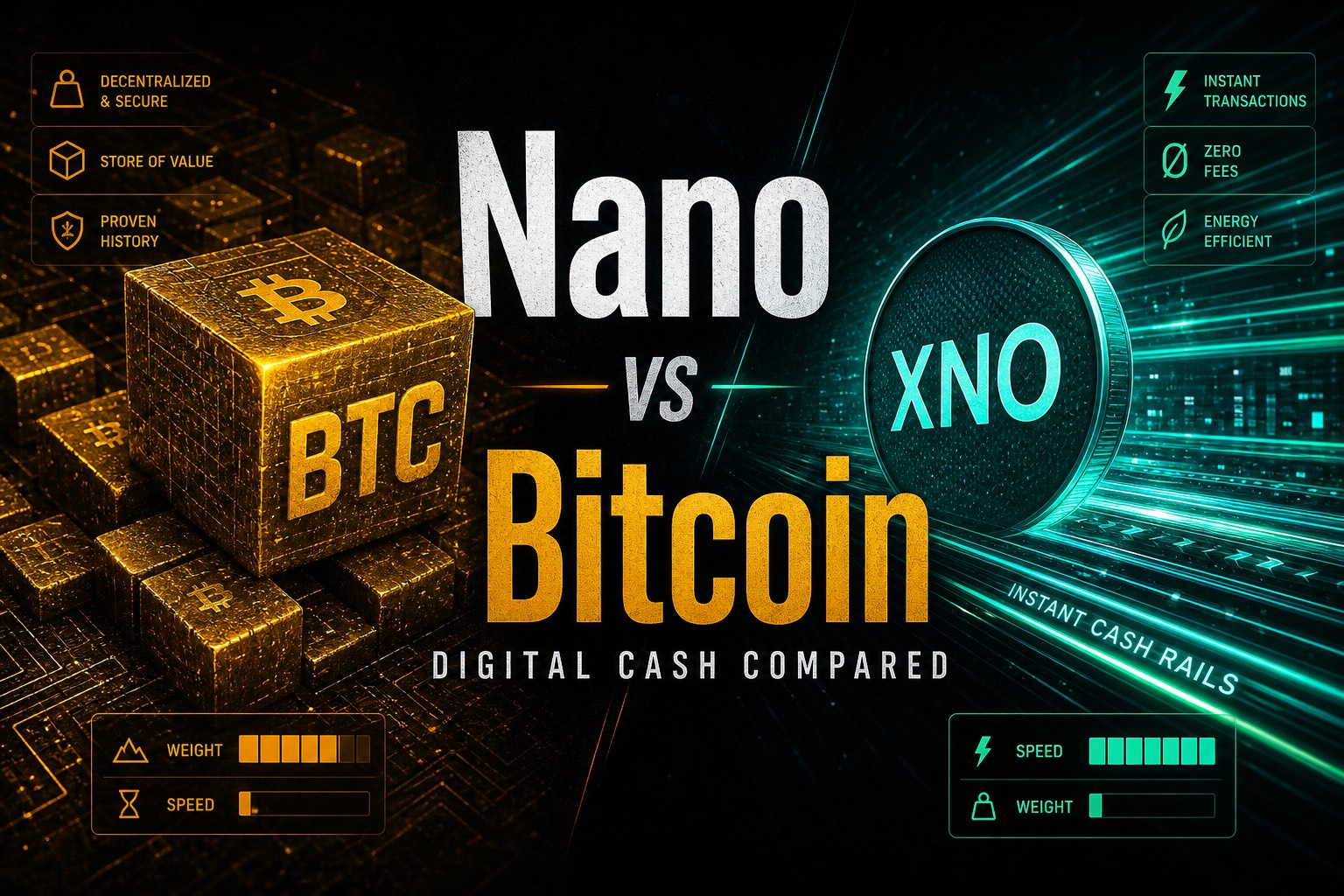
比特币 is often framed as digital gold, while Nano is designed around the narrower payment experience: fast settlement, no transaction fee, and a wallet flow that feels closer to sending a message than broadcasting a costly transaction.
- 比特币 fees and confirmation policy are acceptable for large value transfers but awkward for tiny payments.
- Lightning improves 比特币's payment experience, but it introduces channel liquidity, routing, and wallet trade-offs.
- Nano keeps the everyday payment claim on the base layer, which is simpler to explain to a new user.
- For a nearby angle on the same theme, continue to 为什么选择 Nano Is 更好 for Microtransactions Than 比特币.
Nano 与比特币: A Real-World Payment Comparison comes down to bitcoin versus nano as digital cash
比特币's design spends real-world resources to protect a scarce monetary ledger. That is why many investors value it as digital gold.
Nano's design removes mining from the payment path and uses Open Representative Voting. The result is a payment experience that feels closer to a message than a settlement batch.
Both systems make trade-offs. 比特币 optimizes for monetary credibility and security history. Nano optimizes for direct payment usability.
Nano uses a block-lattice architecture where accounts update their own chains. The network reaches agreement through Open Representative Voting, not mining. Because there are no miners to pay and no gas market to bid into, the user-facing payment experience can stay feeless. For the consensus side, keep 如何 Nano's Open Representative Voting Works open with this article, because Nano's economics and technical design are tied together.
The fixed supply of about 133.25 million XNO also changes the economic story. New coins are not mined into existence, and the protocol does not rely on transaction fees as a long-term security budget. That combination makes Nano different from proof-of-work coins and many smart contract networks, which is why Nano Tokenomics Explained: Fixed Supply, No 费用, No Mining is worth reading next.
Related Nano wiki links
This page is part of the xno.money Nano knowledge base. Read it together with these articles so the topic connects to fees, finality, tokenomics, and real payment use instead of standing alone.
取舍与风险
Nano's simplicity is also its trade-off. It does not offer the broad smart contract ecosystem of Ethereum, the brand dominance of 比特币, or the price stability of dollar-backed stablecoins. People who need programmable finance, institutional liquidity, or stable accounting may prefer other tools. For a more balanced frame, read The Honest Case for Nano: Strengths, Risks, and Future.
- 比特币 has far stronger liquidity, brand recognition, custody infrastructure, and institutional demand.
- Nano has less market depth and less broad merchant acceptance.
- Payment experience alone does not guarantee adoption.
Source notes
Figures in this article are educational benchmarks, not trading advice. Live exchange prices, fees, withdrawal limits, and payment-provider terms can change, so use the source links as starting points and verify current conditions before making decisions.
- Nano documentation Protocol design, ORV consensus, finality, units, and supply.
- 比特币 reference documentation Block confirmations and proof-of-work settlement context.
常见问题
Is Nano 与比特币: A Real-World Payment Comparison a reason to buy Nano?
No single article should be treated as financial advice. Nano can be useful technology while still being a volatile cryptocurrency with adoption, liquidity, custody, and market risks.
什么 makes Nano different from many cryptocurrencies?
Nano focuses on simple payments with zero transaction fees, fast settlement, fixed supply, no mining, and Open Representative Voting instead of proof-of-work mining.
Is Nano trying to replace 比特币?
Nano and 比特币 are usually framed differently. 比特币 is often treated as digital gold, while Nano is designed around fast feeless digital cash for direct payments.